
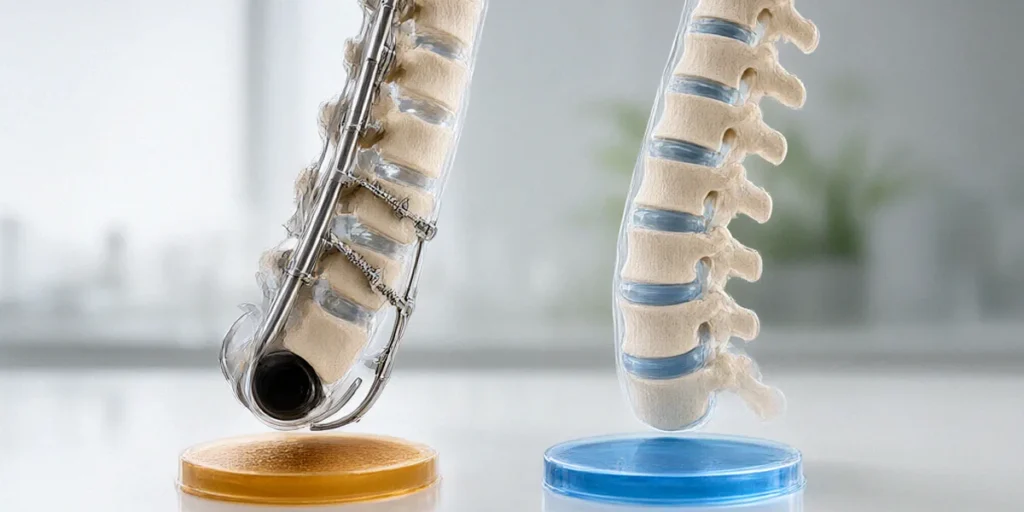
Spinal Fusion vs Motion Preservation: What Canadian Patients Need to Know
You’ve tried physiotherapy, anti-inflammatories, and maybe even a facet joint injection or two. Yet the back pain keeps returning, and your family doctor has finally mentioned the word “surgery.” Now you’re staring at two very different paths: spinal fusion, the tried-and-true approach, or motion preservation, a newer option that keeps your spine moving. For Canadian patients, the decision isn’t just medical — it’s tangled up with wait times, provincial health coverage, and which procedures your surgeon is actually able to offer. We’ve put together this guide to help you understand both approaches before you sit down with your orthopaedic specialist.
Understanding Spinal Fusion: The Traditional Approach
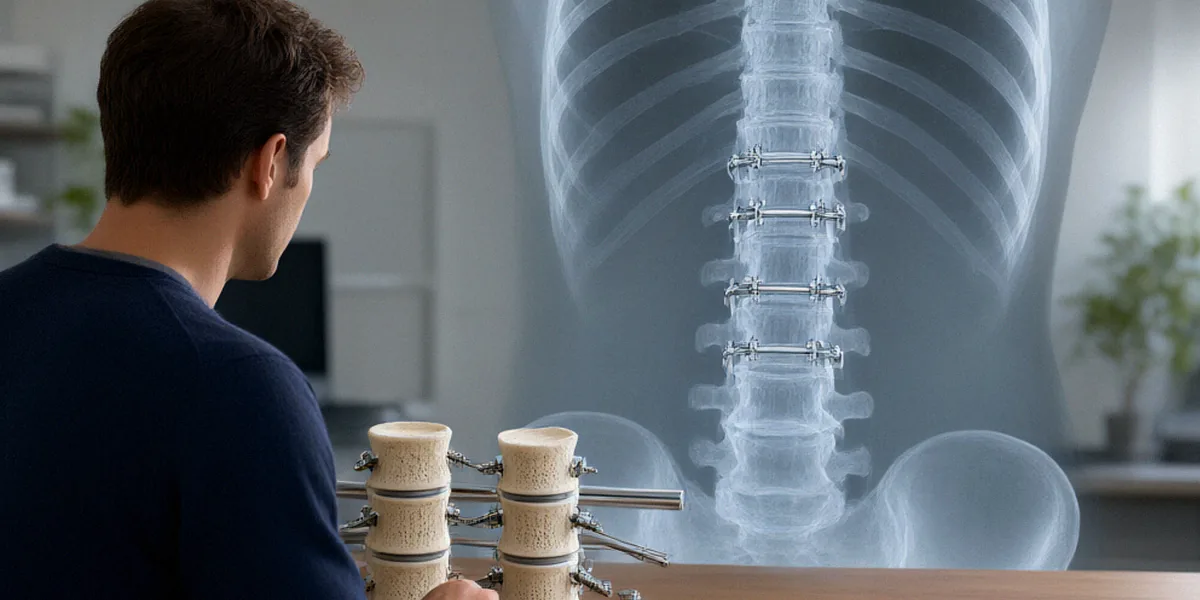
Spinal fusion has been the gold standard for treating structural spine problems for decades. The concept is straightforward: two or more vertebrae are permanently joined together so they heal into a single solid unit. This stops the painful motion between those segments, which is often the root of the problem in conditions like degenerative disc disease and spondylolisthesis.
How Spinal Fusion Works
During a fusion procedure, your surgeon places bone graft material between the affected vertebrae. Metal hardware — typically pedicle screws and rods — holds everything in place while the bone grows and fuses. In Canada, some of the most common implant systems come from Medtronic and DePuy Synthes, both of which have long track records in Canadian hospitals. The hardware doesn’t stay visible forever; its job is to stabilize the spine during the months it takes for the fusion to become solid.
Common Conditions Treated with Fusion
Fusion is generally recommended when the spine has become unstable or when a specific segment is generating pain that other treatments can’t control. Typical candidates include:
- Degenerative disc disease that has not responded to conservative care
- Spondylolisthesis, where one vertebra slips forward over another
- Spinal stenosis with instability
- Fractures or deformities such as scoliosis
- Recurrent disc herniation requiring revision surgery
Pros and Cons of Fusion
The biggest advantage of fusion is its track record. Surgeons have performed it for decades, and the outcomes are well documented. It reliably addresses instability and can significantly reduce leg and back pain for the right candidate. The downside is that fusing a segment transfers stress to the levels above and below it, which can accelerate degeneration there over time — sometimes leading to further surgery. Recovery is also lengthy, and patients lose flexibility at the fused level.
What Is Motion Preservation? An Alternative to Fusion
Motion preservation is exactly what it sounds like: surgery that addresses the painful disc or joint without locking the spine into place. Instead of eliminating movement, these procedures aim to restore more natural motion. The best-known example is artificial disc replacement, using devices such as the ProDisc or Charité artificial discs, which have been implanted in Canadian patients for years.
Types of Motion Preservation Surgeries
There are two main categories we see in practice. The first is total disc replacement, where the damaged disc is removed and replaced with an artificial one that allows the segment to bend and rotate. The second is dynamic stabilization, which uses flexible rods, screws, or spacers to limit — but not eliminate — movement at the affected level. Some surgeons also use interspinous spacers for specific cases of stenosis.
How Motion Preservation Differs from Fusion
The philosophical difference is significant. Fusion says “stop the motion, stop the pain.” Motion preservation says “keep the motion, but make it pain-free.” That means less stress on adjacent levels and, in theory, fewer future problems. It also means the procedure is more technically demanding and requires careful patient selection — not everyone is a candidate.
Potential Benefits and Risks
Patients who qualify for disc replacement often report faster return to activity and preserved range of motion. However, motion preservation isn’t risk-free. Implant wear, device failure, and the need for revision surgery are real possibilities, and long-term data — while encouraging — is shorter than what we have for fusion. Some patients also find that their provincial health coverage does not extend to motion preservation procedures, which we’ll get into next.
Key Considerations for Canadian Patients
Here’s where the Canadian healthcare context really matters. What’s medically appropriate and what’s accessible through your provincial system aren’t always the same thing.
Access and Wait Times in Canada
Wait times for spine surgery in Canada can exceed six months in many provinces, and in some regions the wait for a first surgical consultation alone stretches past a year. If you’re considering motion preservation, that wait can be even longer because fewer surgeons perform these procedures. The Canadian Spine Society has published guidelines and position statements emphasizing timely access to care, but the reality on the ground varies widely by province and health region.
Questions to Ask Your Surgeon
When you finally get in front of a surgeon, come prepared. We suggest asking:
- Am I a candidate for motion preservation, or is fusion the safer option for my specific condition?
- How many of these procedures have you performed, and what are your outcomes?
- Which implant system do you use, and why?
- What does recovery look like in terms of weeks off work and rehabilitation?
- If this surgery fails, what are my revision options?
Cost and Insurance Coverage
Provincial health coverage may cover spinal fusion but not always motion preservation. In provinces where artificial disc replacement isn’t insured, patients may face out-of-pocket costs in the tens of thousands of dollars, or they may need to pursue private options. It’s essential to confirm coverage in writing before committing to a procedure. Some patients also travel outside their home province for surgery, which adds travel and accommodation costs to the equation.
Facet Joints and Back Pain: Why They Matter in Surgery
Before any surgeon recommends fusion or motion preservation, they need to figure out where your pain is actually coming from. Facet joints — the small joints at the back of each vertebra that guide spinal motion — are involved in a surprising number of chronic back pain cases.
The Role of Facet Joints in Spinal Health
Facet joints allow your spine to bend, twist, and extend while keeping the vertebrae aligned. When they degenerate, become inflamed, or develop arthritis, they can generate pain that mimics disc problems. Facet joint pain is often felt in the lower back and can radiate into the buttocks or thighs, making it tricky to distinguish from discogenic pain.
How Facet Joint Issues Are Treated
Facet joint injections are used diagnostically in Canada to confirm whether a specific joint is the pain generator. A small amount of local anesthetic and steroid is injected near the joint; if your pain disappears temporarily, that’s a strong clue. If injections provide relief, conservative management may be enough. If they don’t, and imaging shows facet degeneration, surgery may enter the conversation.
Impact on Surgical Decision-Making
Facet joint health directly influences whether you’re a candidate for motion preservation. Artificial disc replacement requires reasonably healthy facet joints at the operative level, because the implant relies on them for stability. If the facets are badly arthritic, fusion may be the safer choice. This is one reason a thorough diagnostic workup — including imaging and possibly injections — matters so much before surgery.
Comparing Outcomes: Fusion vs Motion Preservation
Research published in the Canadian Journal of Surgery and data from international spine registries give us a reasonable picture of how these two approaches compare. Neither is universally superior — it depends on the patient and the condition.
Short-Term Recovery and Rehabilitation
Motion preservation patients often return to light activity faster, sometimes within a few weeks, because there’s no need to wait for a fusion to solidify. Fusion patients typically face a longer rehabilitation period, often three to six months before returning to full duties, and heavy lifting may be restricted even longer.
Long-Term Durability and Reoperation Rates
Fusion has a well-documented reoperation rate, largely driven by adjacent segment degeneration. Motion preservation may reduce that risk, but it introduces its own concerns around implant wear and device failure. Registry data suggests overall reoperation rates are broadly comparable at ten years, though the reasons differ.
Patient Satisfaction and Quality of Life
Satisfaction studies generally show high rates for both procedures when patients are appropriately selected. Motion preservation tends to score slightly better on measures of flexibility and return to recreational activity, while fusion tends to score better on pain relief in cases involving significant instability.
Making the Right Choice for Your Spine
There’s no universal “best” surgery. The right choice depends on your diagnosis, your facet joint health, your age and activity level, and what’s actually available through your provincial system.
Factors to Discuss with Your Healthcare Team
Bring your full history to the table: prior injections, imaging results, response to physiotherapy, and your personal goals. If you’re a runner, a nurse, or a grandparent who wants to lift grandchildren, say so — those details shape the recommendation.
The Importance of Second Opinions
A second opinion isn’t a sign of distrust; it’s standard practice for major spine surgery. Different surgeons have different training and comfort levels with motion preservation, and a second perspective can reveal options you hadn’t considered.
Questions to Ask About Implants and Techniques
Ask which implant brand your surgeon plans to use, whether it’s approved by Health Canada, and what the revision strategy would be if something goes wrong. Organizations like the Canadian Spine Society and patient advocacy groups can help you find surgeons experienced in both approaches.
FAQ
Is motion preservation covered by provincial health insurance in Canada?
It varies. Spinal fusion is generally covered when medically necessary, but motion preservation procedures like artificial disc replacement are not consistently insured across provinces. Always confirm coverage with your provincial health plan and your surgeon’s office before scheduling.
How long is the wait for spine surgery in Canada?
Wait times for spine surgery in Canada can exceed six months in many regions, and the wait for an initial surgical consultation can be even longer. Access varies significantly by province and by the specific procedure.
Are facet joint injections painful?
Most patients describe facet joint injections as mildly uncomfortable rather than painful. The procedure is brief, uses local anesthetic, and is performed on an outpatient basis. They’re used diagnostically in Canada to identify whether a facet joint is the source of your pain.
Which implant brands are commonly used in Canada?
Medtronic and DePuy Synthes are among the most common implant brands used in Canadian spine surgery. For motion preservation, devices like the ProDisc and Charité artificial discs have been used in Canada for years.
Can I choose between fusion and motion preservation?
Sometimes, but not always. Your candidacy depends on your diagnosis, facet joint health, bone quality, and the number of levels involved. A thorough evaluation by a Canadian orthopaedic or spine surgeon is essential before making that decision.
Whether you ultimately choose fusion or motion preservation, the decision should be made with a full picture of your condition, your goals, and the realities of the Canadian healthcare system. Talk to your surgeon, ask hard questions, get a second opinion if you need one, and remember that the best surgery is the one tailored to your spine — not someone else’s.